

LIC’s Jeevan Umang Plan 745 (UIN: 512N312V03) is a participating whole life insurance plan from the Life Insurance Corporation of India that combines lifelong life cover with a regular yearly payout. It is designed for people who want life insurance protection up to age 100, along with a fixed annual survival benefit and a lump-sum maturity benefit. This page explains the plan’s features, eligibility, premium terms, benefits, and how it compares with other LIC plans, based on LIC’s official Jeevan Umang sales brochure and Customer Information Sheet (CIS) for UIN 512N312V03.
Note: LIC previously sold an earlier version of this plan – Jeevan Umang Plan No. 945 (UIN: 512N312V02) – which was withdrawn from sale with effect from 1 October 2024. This page is about the current Plan 745 (UIN: 512N312V03). If you hold a policy issued under the older Plan 945, see the “Plan 945 vs Plan 745” section below.
What is LIC Jeevan Umang Plan 745?
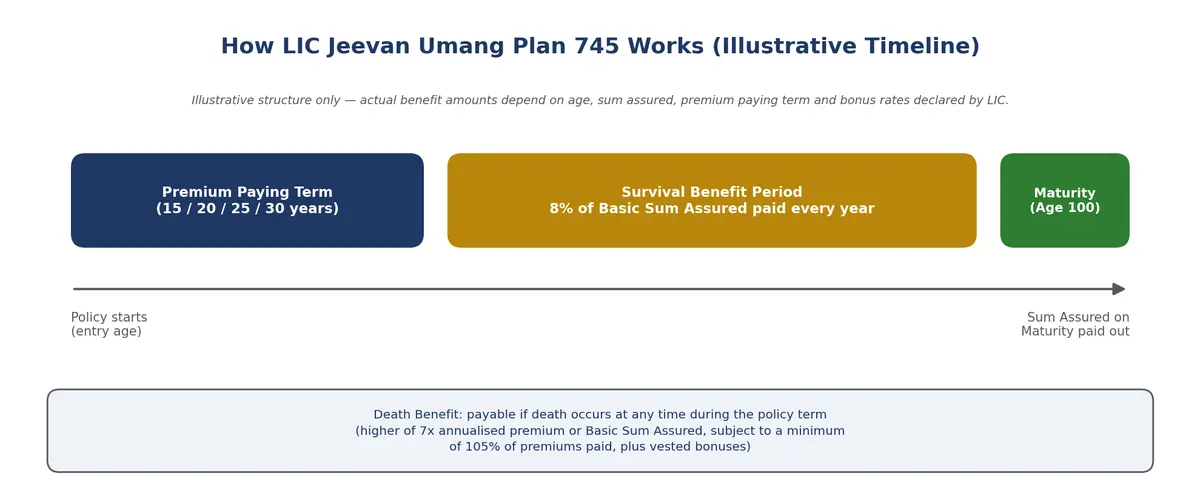
LIC Jeevan Umang is a Participating (Par), Non-Linked, Individual, Savings, Whole Life Insurance Plan. It is built around three payouts: a yearly survival benefit that starts once the premium paying term (PPT) ends, a maturity benefit if the life assured survives to age 100, and a death benefit payable to the nominee if the life assured dies during the policy term. Because premiums are payable only for a limited period (15, 20, 25 or 30 years) while the life cover and survival benefit continue for the whole of life, the plan is often used for long-term goals such as supplementing income in later years, alongside a life insurance safety net.
LIC Jeevan Umang Plan 745 – Key Details
| Parameter | Details |
|---|---|
| Plan Name | LIC’s Jeevan Umang |
| Plan Number | 745 |
| UIN | 512N312V03 |
| Plan Type | Participating (Par), Non-Linked |
| Category | Individual, Savings, Whole Life Insurance Plan |
| Premium Payment Modes | Yearly, half-yearly, quarterly, monthly (via NACH only), or salary deduction |
| Premium Paying Term (PPT) | 15, 20, 25 or 30 years (as chosen at entry) |
| Policy Term | Whole of life – cover continues up to age 100 years (nearer birthday) |
| Survival Benefit | 8% of Basic Sum Assured, paid every year from the end of the PPT until the earlier of death or the policy anniversary before maturity |
| Maturity Benefit | Basic Sum Assured along with vested bonuses, if the life assured survives to age 100 |
| Death Benefit | Higher of 7 times the annualised premium or the Basic Sum Assured, plus vested bonuses, subject to a minimum of 105% of total premiums paid |
| Minimum Basic Sum Assured | Rs. 2,00,000 |
| Maximum Basic Sum Assured | No maximum limit (subject to LIC’s underwriting policy) |
| Optional Riders | 4 riders available (see Key Features below) |
| Loan Facility | Available on the policy, subject to LIC’s terms and conditions |
Source: LIC’s official Jeevan Umang Sales Brochure and Customer Information Sheet for UIN 512N312V03 (see References section below). Figures shown are those stated in LIC’s official documents at the time of writing and may be revised by LIC from time to time.
Key Features of LIC Jeevan Umang Plan 745
- Whole life coverage: Life cover continues up to age 100 years, not just for a fixed term.
- Limited premium payment: Choose to pay premiums for just 15, 20, 25 or 30 years, while benefits continue for life.
- Yearly survival benefit: Once the premium paying term is over, you receive 8% of the Basic Sum Assured every year for as long as you live (up to the policy anniversary before maturity).
- Maturity benefit: If you survive to age 100, the Basic Sum Assured plus any vested bonuses is paid out.
- Participating plan: The policy is eligible for Simple Reversionary Bonus, which LIC may declare each year during the premium paying term; once declared, these bonuses form a guaranteed part of the benefit. A Final Additional Bonus may also be payable in the year of claim, if declared by LIC.
- Death benefit protection: If the life assured dies during the policy term, the nominee receives a death benefit as described above, regardless of whether survival benefits have already been paid.
- Optional riders: Enhance coverage with LIC’s Accidental Death and Disability Benefit Rider, LIC’s Accident Benefit Rider, LIC’s New Term Assurance Rider, or LIC’s Premium Waiver Benefit Rider (combined rider premium cannot exceed 30% of the base plan premium).
- Loan facility: The policy can be used to avail a loan once it acquires a surrender value, subject to LIC’s conditions.
- Grace period: 30 days for yearly, half-yearly or quarterly premiums, and 15 days for monthly premiums.
- Rebates: Mode rebates of 2% (yearly) and 1% (half-yearly), and a High Sum Assured Rebate of up to 4 per mille of the Basic Sum Assured for sums assured of Rs. 25 lakh and above.
Note: The earlier bullet about a “critical illness rider” on this page has been corrected – LIC’s Jeevan Umang Plan 745 does not currently offer a critical illness rider. The four riders listed above are the riders stated in LIC’s official documentation for this plan.
Benefits of LIC Jeevan Umang Plan 745
Survival Benefit
Once the premium paying term is complete, LIC pays a survival benefit of 8% of the Basic Sum Assured every year, for as long as the life assured survives, up to the policy anniversary immediately before the date of maturity. This is the plan’s regular income-style feature and is paid in addition to any bonuses.
Maturity Benefit
If the life assured survives to the maturity date (age 100 years, nearer birthday), the Basic Sum Assured is paid out along with any vested Simple Reversionary Bonuses and Final Additional Bonus that LIC has declared. This is separate from, and in addition to, the yearly survival benefits already received.
Death Benefit
If death occurs before the risk on the policy has commenced, LIC returns the premiums paid (excluding taxes and any rider premiums), without interest.
If death occurs after the risk has commenced, the death benefit is the higher of 7 times the annualised premium or the Basic Sum Assured, plus any vested Simple Reversionary Bonus and Final Additional Bonus, subject to an overall minimum of 105% of the total premiums paid up to the date of death.
Bonuses
As a participating plan, Jeevan Umang is eligible for a Simple Reversionary Bonus, which LIC may declare each year during the premium paying term based on its actual financial experience. According to LIC’s official documentation, once a Simple Reversionary Bonus is declared, it forms part of the guaranteed benefits of the policy. A Final Additional Bonus may also be declared by LIC in the year a claim (death or maturity) arises. Bonus rates are not fixed in advance, are not guaranteed for future years, and are entirely at LIC’s discretion based on its performance – this page does not assume or imply any specific bonus rate.
Eligibility Conditions for LIC Jeevan Umang Plan 745
| Parameter | Details |
|---|---|
| Minimum Entry Age | 30 days (completed) |
| Maximum Entry Age | 55 years (PPT 15) / 50 years (PPT 20) / 45 years (PPT 25) / 40 years (PPT 30) – all nearer birthday |
| Maturity Age | 100 years (nearer birthday) |
| Policy Term | (100 minus age at entry) years |
| Premium Paying Term (PPT) | 15, 20, 25 or 30 years |
| Minimum Age at End of PPT | 18 years (completed) |
| Maximum Age at End of PPT | 70 years (nearer birthday) |
| Minimum Basic Sum Assured | Rs. 2,00,000 |
| Maximum Basic Sum Assured | No limit (in multiples of Rs. 25,000 up to Rs. 4,50,000; Rs. 50,000 up to Rs. 9,00,000; and Rs. 1,00,000 thereafter) |
Premium Payment Terms
LIC does not publish one fixed premium for Jeevan Umang, because the actual premium payable depends on individual factors. This page does not include a premium calculator, as this website does not currently have a functioning LIC premium calculator tool. To get an exact premium quote, use LIC’s official premium calculator or speak to a licensed LIC agent. The main factors that affect your Jeevan Umang premium are:
- Age at entry: A younger entry age generally results in a lower premium for the same Basic Sum Assured.
- Basic Sum Assured chosen: A higher sum assured means a higher premium, though a High Sum Assured Rebate applies for sums assured of Rs. 25 lakh and above.
- Premium Paying Term: Choosing a shorter PPT (for example, 15 years instead of 30 years) generally means a higher periodic premium, since the same overall commitment is compressed into fewer years.
- Premium payment mode: Yearly mode carries a 2% rebate and half-yearly a 1% rebate; monthly (NACH) and quarterly modes do not carry a mode rebate.
- Riders opted for: Adding riders such as Accident Benefit or Premium Waiver Benefit increases the total premium, subject to the 30% cap on rider premium mentioned earlier.
- Underwriting outcome: Health, occupation, and other underwriting factors assessed by LIC at the time of proposal can affect the premium.
Illustrative Example (Not an Official LIC Quotation)
This example is illustrative only, to help you understand how the benefit structure works. It is not an official LIC quotation, does not include a premium amount, and does not guarantee any return, bonus, or amount. Actual benefits depend on the policy you buy, LIC’s underwriting, and bonus rates LIC declares in future, which are not known in advance.
Suppose a person chooses a Basic Sum Assured of Rs. 5,00,000 with a 20-year premium paying term. Based purely on LIC’s published survival benefit and maturity benefit formulas (not on any assumed premium or bonus rate):
- During the 20-year PPT, the person pays premiums as per LIC’s premium chart (not shown here, as this varies by age, health and mode).
- From year 21 onward, the person would receive a survival benefit of 8% of Rs. 5,00,000 = Rs. 40,000 every year, for as long as they live, up to the policy anniversary before maturity.
- If they survive to age 100, they would additionally receive the Basic Sum Assured of Rs. 5,00,000, plus any Simple Reversionary Bonus and Final Additional Bonus vested on the policy (bonus amounts are not known in advance and are not guaranteed for future years).
- If death occurs during the policy term, the nominee would receive the higher of 7 times the annualised premium or Rs. 5,00,000, plus vested bonuses, subject to a minimum of 105% of premiums paid.
Who Should Consider LIC Jeevan Umang Plan 745
LIC Jeevan Umang may be worth considering for people who want:
- Life insurance cover that continues for the whole of life (up to age 100), not just for a fixed term.
- A limited premium payment period, after which no further premiums are due but benefits continue.
- A regular yearly payout in later years (for example, to supplement other retirement income), alongside life cover.
- Exposure to a traditional, bonus-linked participating plan rather than a market-linked investment product.
- A disciplined, long-term savings habit combined with insurance protection.
This is general information, not personalised financial advice. Whether this plan is “the best” option depends on your own financial goals, existing insurance and investment portfolio, and risk appetite – this is not the same for everyone.
Who May Not Find LIC Jeevan Umang Suitable
- People looking for the largest possible life cover at the lowest possible premium, since pure term insurance plans typically offer a much higher sum assured for a similar premium (see the comparison with term insurance below).
- Investors comfortable with market risk who are seeking potentially higher, market-linked returns – traditional participating plans like Jeevan Umang are not designed to compete with market-linked investment products on returns.
- People who may need to access their money in the short term, since surrendering a whole life plan early usually returns significantly less than the total premiums paid.
- Those who already have adequate life cover and are looking only for a pure investment avenue without an insurance component.
LIC Jeevan Umang vs Other LIC Plans
Different LIC plans are designed for different purposes. The comparisons below are based on LIC’s official brochures for each plan and are meant to help you understand structural differences – not to claim that one plan is universally “better” than another.
Jeevan Umang vs LIC Jeevan Utsav
LIC Jeevan Utsav (UIN: 512N363V02) is a Non-Participating whole life plan, unlike Jeevan Umang, which is Participating. Jeevan Utsav offers a shorter premium paying term range (5 to 16 years) and a fixed regular income option of 10% of the Basic Sum Assured every year (or a Flexi Income option with accumulated interest), but it does not pay a separate maturity benefit – the plan is structured as income-for-life rather than income-plus-maturity-lump-sum. Jeevan Umang, in contrast, pays a smaller 8% annual survival benefit but adds a Basic-Sum-Assured maturity payout at age 100, plus the possibility of bonuses since it participates in LIC’s profits.
Jeevan Umang vs Other LIC Whole Life / Endowment Plans
Plans such as LIC Jeevan Anand are structured differently: Jeevan Anand pays its Sum Assured on Maturity as a single lump sum at the end of the policy term (rather than yearly survival benefits), and then continues a reduced life cover (equal to the Basic Sum Assured) for the rest of the policyholder’s life after maturity, as per LIC’s official plan document. Jeevan Umang, by comparison, spreads out payouts as yearly survival benefits after the PPT and also pays a full maturity benefit at age 100. Similarly, plans like LIC Jeevan Labh are limited-premium endowment plans built mainly around a lump-sum maturity payout rather than periodic survival benefits. Always check the specific plan’s own brochure for its exact structure before comparing.
Jeevan Umang vs Term Insurance
A pure term insurance plan, such as LIC’s Jeevan Amar, typically provides a much larger life cover for a much lower premium than a savings-oriented plan like Jeevan Umang – but it generally pays nothing back if the life assured survives the policy term (unless a return-of-premium variant is chosen, which costs more). Jeevan Umang, on the other hand, combines a smaller amount of life cover with a savings component that pays money back to the policyholder during their lifetime through the survival benefit, and again at maturity. Different plans serve different purposes: term insurance is generally more cost-effective for pure protection needs, while participating whole life plans like Jeevan Umang suit people who also want a long-term, insurance-linked savings element.
LIC Jeevan Umang Plan 945 vs Plan 745 – What Changed?
LIC revises its plans from time to time, and each version is given a new Plan Number and UIN (Unique Identification Number, allotted by IRDAI). Jeevan Umang has gone through this process:
| Detail | Plan 945 (UIN: 512N312V02) – Withdrawn | Plan 745 (UIN: 512N312V03) – Current |
|---|---|---|
| Status | Withdrawn from sale with effect from 1 October 2024 | Available for new business from 1 October 2024 onward |
| Availability | Cannot be purchased today; existing policies continue as per their original terms | This is the version currently available for new purchases |
| Overall Structure | Same core concept – participating whole life plan with survival benefit, maturity benefit and death benefit | Same core concept, updated as per LIC’s current terms and conditions |
Important: This page describes the current Plan 745 (UIN: 512N312V03) only, based on its official sales brochure and CIS. If you already hold a policy issued under the older Plan 945, your policy continues to be governed by the terms, conditions, premium and bonus structure that applied when it was issued – not by the current Plan 745 brochure. For the exact terms of an existing Plan 945 policy, please refer to your original policy document or contact LIC directly, rather than relying on this page.
LIC Jeevan Umang Latest Update
Last Updated: September 2026. This page was reviewed against LIC’s official Jeevan Umang Sales Brochure, Customer Information Sheet and Policy Document for UIN 512N312V03, and LIC’s official disclosure on modified products effective 1 October 2024. The only confirmed change reflected here is the withdrawal of the earlier Plan 945 (UIN: 512N312V02) effective 1 October 2024 and the availability of the current Plan 745 (UIN: 512N312V03) from the same date. We have not identified any other officially announced change to Jeevan Umang’s terms beyond this. If LIC revises the plan’s features, eligibility, or premium terms in future, this section will be updated to reflect verified changes only.
Frequently Asked Questions – LIC Jeevan Umang Plan 745
LIC Jeevan Umang Plan 745 (UIN: 512N312V03) is a participating, whole life insurance plan from LIC that pays a yearly survival benefit of 8% of the Basic Sum Assured after the premium paying term ends, plus a maturity benefit if the life assured survives to age 100, and a death benefit if death occurs during the policy term.
The UIN of the current LIC Jeevan Umang plan is 512N312V03, and its Plan Number is 745. The earlier version had UIN 512N312V02 (Plan No. 945) and was withdrawn from sale on 1 October 2024.
Yes. LIC Jeevan Umang is classified by LIC as a Participating, Non-Linked, Individual, Savings, Whole Life Insurance Plan. Cover continues up to age 100 years, even though premiums are payable for a shorter, chosen period.
The minimum entry age is 30 days (completed). The maximum entry age depends on the premium paying term chosen: 55 years for a 15-year PPT, 50 years for a 20-year PPT, 45 years for a 25-year PPT, and 40 years for a 30-year PPT (all nearer birthday).
The minimum Basic Sum Assured under LIC Jeevan Umang Plan 745 is Rs. 2,00,000. There is no maximum limit, subject to LIC's underwriting policy.
You can choose to pay premiums for 15, 20, 25 or 30 years. Once the chosen premium paying term ends, no further premiums are due, but the policy's benefits continue.
After the premium paying term ends, LIC pays 8% of the Basic Sum Assured every year for as long as the life assured survives, up to the policy anniversary immediately before the maturity date.
If the life assured survives to age 100 (nearer birthday), LIC pays the Basic Sum Assured along with any vested Simple Reversionary Bonus and Final Additional Bonus that has been declared.
If death occurs after the risk on the policy has commenced, the death benefit is the higher of 7 times the annualised premium or the Basic Sum Assured, plus vested bonuses, subject to a minimum of 105% of total premiums paid. If death occurs before risk commencement, LIC returns the premiums paid, without interest.
Yes. As a participating plan, Jeevan Umang is eligible for a Simple Reversionary Bonus, which LIC may declare each year during the premium paying term, and a Final Additional Bonus that may be declared in the year of a claim. Once declared, Simple Reversionary Bonuses form part of the guaranteed benefits, but future bonus rates are not fixed or guaranteed in advance.
Four optional riders are available as per LIC's official documentation: LIC's Accidental Death and Disability Benefit Rider, LIC's Accident Benefit Rider, LIC's New Term Assurance Rider, and LIC's Premium Waiver Benefit Rider. Combined rider premium cannot exceed 30% of the base plan premium.
Plan 945 (UIN: 512N312V02) was withdrawn from sale with effect from 1 October 2024, and Plan 745 (UIN: 512N312V03) has been available for new business from the same date. Both share the same core structure of a participating whole life plan with survival, maturity and death benefits, but the exact terms applicable to a policy depend on which UIN it was issued under.
No. Plan 945 (UIN: 512N312V02) was withdrawn from sale with effect from 1 October 2024 and cannot be purchased today. Only the current Plan 745 (UIN: 512N312V03) is available for new policies. Existing Plan 945 policyholders continue to be covered under their original policy terms.
Yes, LIC's official documentation states that a loan facility is available under this plan once it acquires a surrender value, subject to LIC's applicable terms and conditions at the time.
LIC allows a grace period of 30 days for yearly, half-yearly or quarterly premiums, and 15 days for monthly premiums, before a policy lapses due to non-payment.
Yes, the policy acquires a Guaranteed Surrender Value after at least two full years' premiums have been paid, and a Special Surrender Value may apply after one full year's premium, as per LIC's surrender value tables. Surrendering early generally returns significantly less than the total premiums paid, so it is best viewed as a long-term commitment.
LIC Jeevan Utsav (UIN: 512N363V02) is a non-participating plan offering a fixed income option (10% of Basic Sum Assured yearly) but no separate maturity benefit, whereas Jeevan Umang is a participating plan with a smaller 8% annual survival benefit plus a Basic Sum Assured maturity payout and possible bonuses.
It can suit people who want a long-term, insurance-linked source of yearly income after their premium paying years are over, alongside life cover. Whether it is the right choice depends on your overall financial goals, existing savings, and risk appetite, so this should not be treated as personalised financial advice.
As with most LIC savings and life insurance plans, premiums paid and benefits received under Jeevan Umang may qualify for tax deduction or exemption under Section 80C and Section 10(10D) of the Income Tax Act, 1961, subject to the conditions specified in the Act, which can change over time. Please check the latest official tax rules or consult a tax advisor before relying on this for planning purposes.
The most reliable source is LIC's own website, licindia.in, including the official Jeevan Umang sales brochure, Customer Information Sheet and policy document for UIN 512N312V03, linked in the References section of this page.
Official LIC References
The information on this page is based on the following official LIC sources for UIN 512N312V03. Please refer to these documents, or contact LIC directly, for the most current and legally applicable terms:
- LIC’s Jeevan Umang – Official Sales Brochure (UIN: 512N312V03)
- LIC’s Jeevan Umang – Customer Information Sheet (CIS)
- LIC’s Jeevan Umang – Policy Document
- LIC’s Jeevan Umang – Official Withdrawn Plan Page (Plan No. 945, UIN: 512N312V02)
- LIC of India – Official Website
Disclaimer: Information on this page is for educational and informational purposes only and does not constitute financial, tax or investment advice. LIC plan features, premiums, benefits, eligibility and policy conditions may change from time to time. Please refer to the latest official LIC documents and your policy terms, or consult a licensed LIC agent or financial advisor, before making a decision.


 explained: eligibility, premium factors, survival & maturity benefits, riders and FAQs, plus how it differs from the older Plan 945.)
LIC’s commitment to providing comprehensive life insurance plans is evident in Jeevan Umang. This versatile policy not only offers a lifelong safety net but also guarantees periodic payouts, ensuring both protection and savings
The unique combination of whole life coverage and periodic money-back benefits offered by Jeevan Umang is highly appealing. This plan not only ensures financial protection for your loved ones but also serves as a source of income during your lifetime
LIC’s Jeevan Umang Plan is an outstanding whole life money-back policy that provides lifelong coverage and regular payouts. This policy offers not only financial security but also a source of income for the policyholder’s entire life. It’s a fantastic way to protect your family’s future
[…] LIC Jeevan Umang Plan | Whole Life Money Back Plan […]
This article provides a clear understanding of the benefits of LIC’s Jeevan Umang plan. With lifelong coverage, periodic money-back benefits, and the potential for bonus additions, it’s a reliable choice for long-term financial planning
The feature of guaranteed additions in Jeevan Umang adds another layer of financial security and makes it even more attractive. LIC’s track record of consistently providing bonuses adds to the credibility of this plan
Whole life money-back insurance is a crucial component of a robust financial plan. Jeevan Umang’s unique features, such as lifelong coverage, periodic
Long-term financial planning is essential, and LIC’s Jeevan Umang plan is a solid choice. With life coverage and regular money-back benefits, it’s a comprehensive policy that secures your family’s financial future
Jeevan Umang is a well-rounded whole life money-back plan, ensuring not only lifelong coverage but also regular payouts. This policy provides not just security but also a dependable source of income
For individuals seeking whole life money-back insurance, this blog offers valuable insights into LIC’s Jeevan Umang plan. The combination of lifelong coverage and periodic financial support is certainly worth considering
Whole life money-back plans like Jeevan Umang are an excellent way to provide for your family’s financial security and create a lifelong source of income. The flexible premium payment options make it even more convenient