

Planning for a steady income after retirement is one of the most important financial decisions an Indian household makes, and LIC’s New Jeevan Shanti is one of the corporation’s flagship products built specifically for this purpose. It is a single-premium deferred annuity plan: you pay a lump sum once, choose how many years you want to wait before the income starts, and then receive a regular, pre-decided pension for as long as you (or you and your spouse) are alive.
Unlike market-linked investments, New Jeevan Shanti does not go up or down with the stock market. The annuity rate applicable to your policy is fixed at the time you buy it, so the income you are promised is the income you receive, regardless of what happens to interest rates or markets afterwards. This makes it a useful building block for people who want at least one predictable, non-market-linked income stream in retirement, even if it is not meant to be their only one.
People typically research this plan when they have a lump sum in hand today – from a maturity payout, a retirement corpus, sale proceeds, or accumulated savings – but do not need income from it immediately. That “not needed immediately” gap is exactly what the deferment period is designed for. It is important to understand one distinction early: the amount you pay (the purchase price) and the amount you will eventually receive as income (the annuity) are two different things, linked by an annuity rate that depends on your age, the purchase price, the deferment period, and the option you choose – not a fixed multiple that is the same for everyone.
What is LIC New Jeevan Shanti?

LIC’s New Jeevan Shanti is a non-linked, non-participating, individual, single-premium deferred annuity plan. In simple terms: you invest once, wait for a period you choose, and then start receiving a guaranteed pension for life.
A few terms are worth understanding upfront, since they come up throughout this guide:
- Single premium: you pay once, as a lump sum, rather than in instalments over the years.
- Deferred annuity: your pension does not start immediately – it starts after a waiting period (“deferment period”) that you select at the time of purchase.
- Single life: the annuity is paid only on your own life; it stops when you pass away.
- Joint life: the annuity continues to a second named person (typically your spouse) for as long as either of you is alive.
- Non-participating: the plan does not share in LIC’s profits through bonuses; your annuity rate is fixed and guaranteed at the outset instead.
- Non-linked: your money is not invested in equity or debt markets on your behalf, so there is no market-linked fluctuation in the promised annuity.
The plan does not pay any maturity benefit at the end of the deferment period in the way an endowment plan pays a maturity sum – instead, the deferment period simply ends and regular annuity payments begin. If the annuitant (or both annuitants, under joint life) dies before annuity payments begin, a death benefit is paid to the nominee instead.
LIC New Jeevan Shanti Plan at a Glance
LIC has revised this plan multiple times since it was first launched. The table below reflects the version currently available for new purchases; a full explanation of the plan’s version history is provided further below so you can see how the product has evolved.
| Feature | Details |
| Plan Name | LIC’s New Jeevan Shanti |
| Plan Number | 758 (current version) |
| UIN | 512N338V08 (current version) |
| Product Type | Non-Linked, Non-Participating, Individual, Savings, Deferred Annuity Plan |
| Premium Type | Single Premium (one-time payment) |
| Annuity Type | Deferred Annuity |
| Life Options | Single Life or Joint Life |
| Deferment Period | 1 year to 5 years (subject to maximum vesting age) |
| Annuity Payment Frequency | Yearly, half-yearly, quarterly or monthly (paid in arrears) |
| Minimum Entry Age | 30 years (last birthday) |
| Maximum Entry Age | 79 years (last birthday) |
| Maximum Vesting Age | 80 years (last birthday) |
| Minimum Purchase Price | ₹1,50,000 (₹50,000 in specified disability-related cases) |
| Maximum Purchase Price | No upper limit, subject to underwriting |
| Loan Facility | Available, subject to conditions and applicable interest rate |
| Surrender Facility | Available at any time, subject to a Guaranteed Surrender Value formula |
| Current Status | Currently available for new purchase under UIN 512N338V08 |
Note: LIC periodically revises annuity rates and, occasionally, the UIN of this plan. Always confirm the latest applicable UIN and annuity rate for your purchase with LIC or a licensed LIC agent before finalising.
Is LIC New Jeevan Shanti Currently Available? (Plan Versions Explained)
Yes – LIC’s New Jeevan Shanti is currently available for new purchase, under Plan No. 758, UIN 512N338V08. LIC revises this plan’s terms and UIN from time to time, and it is important not to confuse the current version with earlier, withdrawn versions of the same product family:
- LIC’s Jeevan Shanti (Plan No. 850) – the original version of this product, launched before the “New Jeevan Shanti” rebrand; its UINs (512N328V01 and 512N328V02) have since been withdrawn.
- LIC’s New Jeevan Shanti (Plan No. 858) – a series of revisions to the rebranded plan, with UINs 512N338V01 through 512N338V06; all of these have since been withdrawn as LIC periodically updates its annuity rates and terms.
- LIC’s New Jeevan Shanti (Plan No. 758, UIN 512N338V07) – a further revision that has itself since been withdrawn and replaced.
- LIC’s New Jeevan Shanti (Plan No. 758, UIN 512N338V08) – the current version available for new purchase.
If you or a family member already hold a policy under an earlier UIN, that policy continues on the terms that applied when it was purchased – a plan being withdrawn for new sales does not affect existing policyholders. Only new purchases go through the currently available version. Because LIC reviews and updates its annuity rates and UINs periodically, always confirm the latest applicable version and rate directly with LIC or a licensed agent at the time of purchase, rather than relying solely on this page or any other secondary source.
How LIC New Jeevan Shanti Works
The plan follows a simple sequence from purchase to payout:
- Choose your annuity option: Single Life or Joint Life.
- Pay the single premium (purchase price): a one-time lump-sum payment.
- Select your deferment period: anywhere from 1 to 5 years, subject to the maximum vesting age of 80.
- The annuity rate is fixed at policy inception: based on your age, the purchase price, the deferment period and the option chosen, in line with the rates applicable on your date of purchase.
- Annuity payments begin after the deferment period: paid in your chosen mode – yearly, half-yearly, quarterly or monthly.
- What happens on death depends on when it occurs and which option was chosen: during deferment, a death benefit is paid; after annuity has started, payments continue only as the policy terms allow (see the dedicated section below).
LIC New Jeevan Shanti Annuity Options
New Jeevan Shanti offers two annuity options. Both are deferred annuities – the difference is whose life the annuity is based on.
Option 1: Deferred Annuity for Single Life
The annuity is based on one person’s life – the annuitant. During deferment there is no survival payout; if the annuitant dies during this period, the nominee receives the death benefit. Once the deferment period ends, the annuitant receives regular payments for as long as they live. On the annuitant’s death after annuity has started, payments stop and the death benefit becomes payable to the nominee.
Option 2: Deferred Annuity for Joint Life
The annuity is based on two lives – typically spouses, though LIC also permits certain other relationships such as parent-child combinations, as per its underwriting rules. During deferment there is no survival payout; if either or both annuitants die during this period, the death benefit is paid only on the death of the last survivor. Once the deferment period ends, payments continue as long as at least one of the two annuitants is alive, and stop only after both have died, at which point the death benefit is paid to the nominee.
The annuity option you choose at the time of purchase generally cannot be changed later, so it is worth thinking through carefully – particularly whether you want the income to continue for a spouse after your own death.
| Aspect | Single Life | Joint Life |
| Basis of annuity | One person (the annuitant) | Two people (primary and secondary annuitant) |
| During deferment, on death | Death benefit paid to nominee | Death benefit paid only after both annuitants have died |
| After deferment, payments continue until | Death of the annuitant | Death of the last surviving annuitant |
| Typically suits | Those without a dependent spouse, or who have independent income arrangements for a spouse | Couples who want the income to continue for whichever spouse survives longer |
Deferment Period Explained
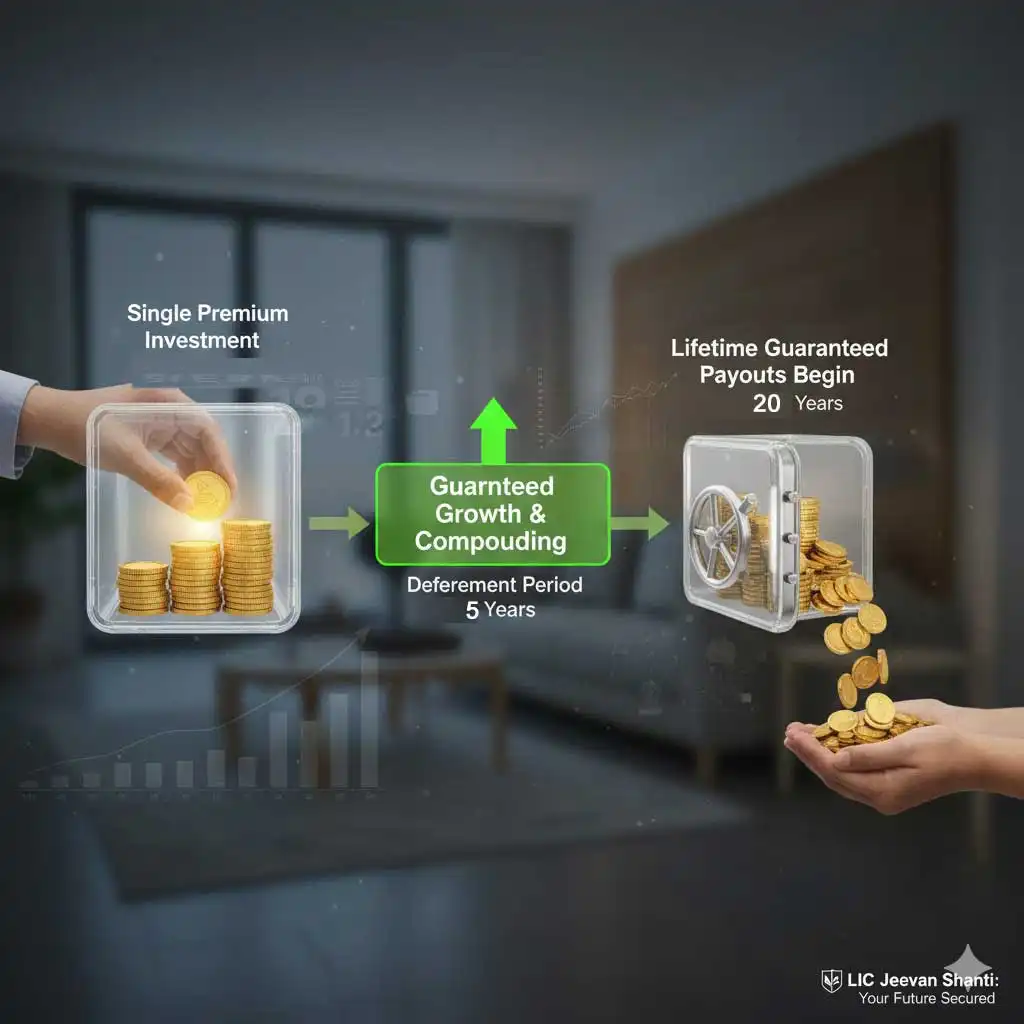
The deferment period is the gap between when you pay the purchase price and when your annuity payments begin. Under New Jeevan Shanti, you can choose any deferment period from 1 to 5 years, as long as your age plus the deferment period does not take you past the maximum vesting age of 80.
Someone might choose a deferred annuity over an immediate one for a simple reason: they have the lump sum now, but do not need the income yet. For example, a person who receives retirement proceeds at 58 but plans to keep working part-time or draw on other income until 62 could choose a 4-year deferment, so that regular annuity payments start closer to when they actually need them – typically at a somewhat more favourable annuity rate than if the same amount were annuitised immediately, since the insurer has longer to hold the funds before payouts begin.
This is the key difference from an immediate annuity plan such as LIC’s Jeevan Akshay, where payments start straightaway after purchase, with no deferment period at all. If you need income right away, a deferred annuity with a multi-year waiting period is not the right fit – an immediate annuity plan would suit that need better. New Jeevan Shanti is built for the “I have the money now, but I need the income later” situation.
LIC New Jeevan Shanti Benefits
Guaranteed annuity rate
The annuity rate applicable to your policy is fixed at the time of purchase and does not change afterwards, regardless of how interest rates or markets move later. This provides predictability that market-linked retirement products cannot offer.
Structured retirement income planning
Because you choose the deferment period, you can time the start of your annuity income to roughly coincide with your actual retirement or the point at which you expect to need it, rather than being forced to start income immediately.
Single premium convenience
You pay once and the policy runs on its own after that – there is no need to remember renewal dates or arrange recurring payments, which some retirees find simpler to manage.
Choice of single life or joint life
You can structure the plan so that income continues for a surviving spouse, or restrict it to your own life if that suits your situation better – see the comparison earlier in this guide.
Choice of annuity payment frequency
Once annuity payments begin, you can receive them yearly, half-yearly, quarterly or monthly, depending on what suits your cash-flow needs.
Death benefit protection
If the annuitant (or, under joint life, the last surviving annuitant) dies, a death benefit is paid to the nominee rather than the policy simply lapsing with no payout. The mechanics of this benefit are explained in detail later in this guide.
Loan and surrender facilities
The plan permits policy loans (after an initial waiting period from policy issuance) and allows surrender at any time, both subject to LIC’s applicable terms and formulas at the time. These exist as safety valves, though LIC’s own literature cautions that surrendering early can involve a significant loss compared to continuing the policy.
LIC New Jeevan Shanti Eligibility
The eligibility conditions for the currently available version of New Jeevan Shanti are as follows:
- Minimum entry age: 30 years (last birthday)
- Maximum entry age: 79 years (last birthday)
- Maximum vesting (annuity-start) age: 80 years (last birthday) – your entry age plus your chosen deferment period cannot exceed this
- Deferment period: 1 to 5 years
- Minimum purchase price: ₹1,50,000, subject to meeting the minimum annuity requirement for your chosen payment mode (a lower minimum of ₹50,000 applies in specified cases where the policy is bought for the benefit of a dependent person with a disability)
- Maximum purchase price: no upper limit, subject to LIC’s underwriting requirements for larger amounts
- Life options: Single Life or Joint Life, as explained above
- Medical requirements: this plan is typically purchased without medical underwriting in the usual sense, since it is an annuity rather than a life-cover product, though LIC may apply its standard due-diligence and source-of-funds checks
Because these figures are periodically reviewed by LIC, always confirm the exact current limits with LIC or a licensed agent before applying.
LIC New Jeevan Shanti Premium (Purchase Price)
In an annuity plan like this one, the amount you pay is called the purchase price rather than a “premium” in the usual sense, since it is a single, one-time payment rather than a recurring one. Several factors determine how much annuity income that purchase price will eventually generate:
- Your age at entry: annuity rates typically increase with age, since a shorter expected payout period allows for a higher rate per rupee invested.
- The deferment period you choose: a longer deferment generally allows for a somewhat higher eventual annuity rate, since LIC holds and grows the funds for longer before payouts start.
- The annuity option chosen: Single Life annuities are generally higher than Joint Life annuities for the same purchase price, since a joint-life annuity is expected to be paid out over a longer combined period.
- The payment frequency: monthly, quarterly and half-yearly payment modes typically work out to a slightly lower effective annual annuity than the yearly mode, since payments are received more frequently.
- The prevailing annuity rate table: LIC revises its annuity rates from time to time in response to interest-rate conditions, so the same purchase price bought today and a year from now may not produce exactly the same annuity income.
Because of this last point, this page does not quote a specific current annuity rate or promise a specific pension amount – any such figure would go stale as soon as LIC next revises its rates. Always request a personalised annuity quotation from LIC or a licensed agent for the exact amount applicable to your age, purchase price, deferment period and chosen option.
LIC New Jeevan Shanti Pension / Annuity Calculation – An Illustration
Illustration only – not a quotation or a guaranteed current LIC rate. Suppose a person invests a lump sum as the single premium under New Jeevan Shanti, chooses Single Life annuity, and selects a deferment period of, say, 3 years. Conceptually, here is what happens:
- LIC applies the annuity rate applicable on the date of purchase, based on the person’s age, the purchase price, the 3-year deferment period, and the Single Life option.
- During the 3-year deferment period, no income is paid out; instead, an “Accrued Additional Benefit” builds up in the background, which matters only if the person dies during this period (see the death benefit section below).
- At the end of the 3 years, regular annuity payments begin in the person’s chosen mode (say, monthly) and continue for the rest of their life.
- If the person had instead chosen a longer deferment period, a higher purchase price, or a later entry age, the resulting periodic annuity would typically have been higher – and choosing Joint Life instead of Single Life would typically have resulted in a somewhat lower periodic annuity for the same purchase price, since it is expected to be paid out for longer.
This walkthrough deliberately avoids stating a specific rupee annuity figure, since LIC’s annuity rates change from time to time and any number quoted here could quickly become outdated or misleading. For an accurate, current figure specific to your age, purchase price, deferment period and chosen option, use LIC’s official annuity calculator or request a quotation from a licensed LIC agent.
Monthly, Quarterly, Half-Yearly and Yearly Annuity
Once your deferment period ends, New Jeevan Shanti lets you receive your annuity in one of four frequencies: monthly, quarterly, half-yearly or yearly, paid in arrears (that is, at the end of each period rather than the start). You choose your preferred mode at the time of purchase.
There are minimum annuity thresholds for each mode, so very small purchase prices may not qualify for more frequent payment modes. As a general guide (subject to LIC’s current figures), the minimum annual annuity works out to roughly ₹12,000 a year, with proportionately lower minimums per instalment for half-yearly, quarterly and monthly modes. Choosing a more frequent mode such as monthly generally suits people who want the annuity to function like a regular income for monthly expenses, while yearly or half-yearly modes may suit those who prefer to manage larger, less frequent inflows.
What Happens During the Deferment Period?
Direct answer: during deferment, there is no income paid out to you. If you survive the full deferment period, you simply move on to receiving annuity payments as scheduled. If you (or, under joint life, both annuitants) die during deferment, no further waiting is required – the death benefit becomes payable to the nominee at that point instead of the plan continuing.
- If you survive the deferment period: no benefit is paid during this phase itself; annuity payments simply begin once the period ends.
- If you die during the deferment period (Single Life): the death benefit is paid immediately to the nominee; the policy then ends.
- If either or both annuitants die during the deferment period (Joint Life): the death benefit is paid only once both annuitants have died; if one survives, the plan continues and moves toward the annuity start date based on the surviving annuitant, as per policy terms.
- What silently builds up in the background: an “Accrued Additional Benefit,” which increases the eventual death benefit the longer the deferment period runs before a death occurs – this is explained in the death benefit section below.
It helps to keep the deferment period and the payout period conceptually separate: deferment is the waiting phase with no income and only a death benefit as protection, while the payout period (after deferment) is when regular annuity income actually starts.
What Happens After the Deferment Period?
Direct answer: once the deferment period ends, LIC begins paying you the annuity in your chosen frequency, and continues doing so for the rest of your life (Single Life) or for as long as either annuitant is alive (Joint Life).
- Payments continue for life: this is a lifetime income stream, not a fixed number of instalments – it does not run out even if you live for many years after the annuity starts.
- Payment frequency: as chosen at purchase – yearly, half-yearly, quarterly or monthly.
- Single Life: payments stop on the annuitant’s death; the death benefit then becomes payable to the nominee.
- Joint Life: payments continue to whichever annuitant survives, and stop only after both have died, after which the death benefit is paid to the nominee.
What Happens After Death? (If I Buy This Plan and Die, What Happens to My Money?)
Direct answer: your money is not lost. A death benefit is paid to your nominee, calculated as explained below, whether death occurs during the deferment period or after annuity payments have started.
| Situation | Single Life | Joint Life |
| Death during deferment period | Death benefit paid to nominee immediately; policy ends | Death benefit paid only after both annuitants have died; if one survives, plan continues |
| Death after annuity has started | Annuity payments stop; death benefit (net of annuity already paid, per the formula below) paid to nominee | Annuity continues to the surviving annuitant; death benefit paid to nominee only after the last survivor’s death |
| Is the original purchase price protected? | Yes – the death benefit formula guarantees at least 105% of the purchase price | Yes, on the same basis, payable after the last survivor’s death |
LIC New Jeevan Shanti Death Benefit – Detailed Explanation
Under the currently available version of the plan, the death benefit is calculated as the higher of the following two amounts:
- Purchase Price, plus the Accrued Additional Benefit built up during deferment, minus the total annuity amount already paid out (if death occurs after annuity payments have started); or
- 105% of the Purchase Price.
The “Accrued Additional Benefit” is a guaranteed addition that builds up only during the deferment period, calculated month by month based on the purchase price and the applicable annuity rate. In effect, it means that if death occurs during deferment, the nominee does not simply get back the original purchase price – they get that amount plus this accrued addition, subject to the 105%-of-purchase-price floor.
How the death benefit can be paid to the nominee
LIC gives the nominee a choice in how to receive this amount:
- As a lump sum: the entire death benefit is paid out at once.
- By purchasing an immediate annuity: the death benefit amount is used to buy an immediate annuity from LIC, converting it into the nominee’s own regular income stream.
- In instalments: spread over a period the nominee selects in advance (subject to LIC’s applicable rules), rather than as a single payment.
This flexibility is useful because a nominee’s needs may be different from the original policyholder’s – a lump sum may suit someone with an immediate need such as clearing a debt, while an annuitised or instalment-based payout may suit a nominee who wants the amount converted into ongoing income instead.
Is LIC New Jeevan Shanti a Good Pension Plan?
It depends on what role you want it to play in your retirement planning – it is not a universal “best” answer for everyone. New Jeevan Shanti is well suited to certain needs and poorly suited to others. Here is a balanced view.
Potential advantages
- Predictable, non-market-linked income: your annuity rate is fixed at purchase and is not affected by later market movements.
- Structured, lifetime retirement income: once annuity starts, it continues for life, protecting against the risk of outliving your savings.
- One-time investment: no need to track or make recurring payments.
- Flexible timing: you can align the deferment period to roughly match your actual retirement date.
- Single-life or joint-life choice: lets you decide whether income should continue for a spouse.
- Death benefit protection: your capital is not simply forfeited if you die before or shortly after the annuity starts.
Important considerations
- Liquidity is limited: your money is locked into a single-premium contract; you can access it early only through loan or surrender, both on LIC’s terms and potentially at a loss.
- Inflation is not automatically addressed: the annuity amount is generally fixed once it starts, so its real purchasing power can decline over a long retirement unless you have factored this in separately.
- Opportunity cost: the lump sum is locked into a fixed-rate product for the long term, and may earn less than what other investment avenues could offer over the same period, depending on market conditions and risk appetite.
- Long-term commitment: this is not designed to be exited early, and the surrender terms are structured to discourage doing so.
- Tax treatment: annuity income is generally taxable as per your income slab (see the tax section below) – it is not a tax-free income stream.
- It is one tool, not a complete retirement plan: most financial planners would suggest combining a product like this with other retirement savings, an emergency fund, and inflation-hedged investments, rather than relying on it alone.
Who May Consider LIC New Jeevan Shanti?
Based on how the plan is structured, it may be worth evaluating if you are in one of these situations. For broader context, you can also browse LIC’s retirement planning resources. This is general information, not personalised financial advice – please assess your own circumstances or consult a licensed advisor.
- People planning retirement income in advance: those who have a lump sum today but expect to need the income only a few years from now.
- People who have just received a retirement-related corpus: such as provident fund, gratuity or superannuation proceeds, who are not yet ready to draw on all of it.
- People who want future annuity income locked in today: at the annuity rate applicable now, rather than waiting and buying an immediate annuity later at whatever rate applies then.
- Individuals planning income to start at a specific future date: for example, timed to when an existing income source (a job, a rental agreement, another pension) is expected to end.
- Couples considering joint retirement income: who want a predictable income stream that continues for whichever spouse lives longer.
Who Should Think Carefully Before Buying?
Equally, this plan may not be the right fit for everyone. Consider these points carefully before committing a lump sum:
- If you need liquidity: a single-premium deferred annuity is not a place to park money you might need to access at short notice.
- If you do not already have an emergency fund: build that separately first, in an easily accessible form, before locking a large sum into this kind of product.
- If inflation protection is a priority: the fixed annuity amount will not automatically keep pace with rising costs over a long retirement.
- If you have other pending high-interest debt: clearing that may be a better use of the lump sum than locking it into a deferred annuity.
- If you already have substantial guaranteed pension income: for example, a government pension – you may not need another fixed-income layer, and could consider growth-oriented alternatives for part of your corpus instead.
- If your tax situation makes the taxable annuity income unattractive: compare the after-tax return against other retirement options available to you.
- If you value flexibility to change your mind: once purchased, the plan’s core terms (option chosen, deferment period) are generally not changeable, and early exit involves a loss through the surrender formula.
LIC New Jeevan Shanti vs LIC Jeevan Akshay
These are LIC’s two main single-premium annuity plans, and the core difference is simple: New Jeevan Shanti is a deferred annuity, while LIC Jeevan Akshay is an immediate annuity. Both are currently available products, but they serve different timing needs.
| Feature | New Jeevan Shanti | Jeevan Akshay |
| Broad annuity type | Deferred annuity | Immediate annuity |
| When income begins | After a deferment period of 1–5 years | Almost immediately after purchase |
| Deferment | Yes, chosen by you | None – there is no deferment period |
| Typical use | You have a lump sum now but need income only later | You need income to start right away, e.g. at retirement |
| Premium | Single premium | Single premium |
| Life options | Single Life / Joint Life | Multiple annuity options, including single life, joint life, and options with return of purchase price |
| Suitable for | Pre-retirees planning income for a future date | Those who have just retired and need income now |
Neither plan is universally “better” – the right choice depends entirely on whether you need income now or later. Some people even use both: an immediate annuity for current income needs and a deferred annuity to lock in a future income stream in advance.
LIC New Jeevan Shanti vs LIC Saral Pension
LIC’s Saral Pension is a different, standardised single-premium immediate annuity plan (a format mandated across insurers by IRDAI, so most insurers offer a similarly structured “Saral Pension” product). Compared to New Jeevan Shanti:
- Income timing: Saral Pension is an immediate annuity – income starts right after purchase, with no deferment period; New Jeevan Shanti is deferred.
- Return of purchase price: Saral Pension’s annuity options are built around guaranteed return of 100% of the purchase price to the nominee on death; New Jeevan Shanti uses a different death benefit formula (the higher of 105% of purchase price or purchase price plus accrued additions, less any annuity paid), as explained earlier in this guide.
- Life options: both plans offer single life and joint life variants.
- Premium: both are single-premium plans.
- Retirement planning use: Saral Pension suits those who want simple, immediate income with a standardised structure; New Jeevan Shanti suits those who specifically want to defer the start of their income.
As with the Jeevan Akshay comparison above, this is not a case of one plan being better than the other in general – it depends on whether you need income immediately or want to defer it, and on how you weigh the two plans’ different death benefit structures.
LIC New Jeevan Shanti vs Other LIC Pension Plans
Broadly, LIC’s retirement-related products fall into a few categories: deferred annuity plans like New Jeevan Shanti, which convert a lump sum into income starting at a future date you choose; immediate annuity plans like Jeevan Akshay and Saral Pension, which start paying out right away; and savings-oriented plans that are not annuities at all but still provide a form of regular income – for example, LIC Jeevan Umang, which pays a yearly survival benefit after its premium-paying term ends, alongside life cover, structured quite differently from a single-premium annuity.
When comparing options, the questions that matter most are: do you want income immediately or later, are you comfortable committing a lump sum as a single premium, and does a lifetime annuity income or an alternative payout structure better match your goals? This page does not make a recommendation between these – explore LIC’s other pension plans and speak to a licensed LIC agent for guidance suited to your situation.
Tax Considerations
This section is general education, not personalised tax advice – tax treatment depends on the nature of the payment, the applicable tax laws at the time, and your individual circumstances, so always confirm the current position with a qualified tax advisor or chartered accountant before making decisions.
- Purchase price payment: depending on the prevailing income tax provisions and your overall eligible deductions, the single premium paid may qualify for a deduction, subject to applicable limits under the Income Tax Act – this is subject to change and should be verified against the current law for the relevant financial year.
- Annuity income: once annuity payments begin, they are generally treated as income in the hands of the recipient and taxed according to the applicable income tax slab, rather than being a tax-free receipt.
- Death benefit: the tax treatment of the death benefit paid to a nominee depends on the applicable provisions at the time of payment and how the benefit is received (lump sum, annuitised, or in instalments).
- Indirect taxes: the applicability of GST or other indirect taxes on annuity purchase prices is set by prevailing government policy and has changed over time, so check the current position rather than relying on older information.
Because tax rules change from time to time, this section deliberately avoids quoting specific current rates, sections or thresholds that could go out of date – please verify the applicable rules for your financial year with LIC or a tax professional.
Pros and Considerations
| Potential Advantages | Important Considerations |
| Annuity rate fixed and guaranteed at purchase | Limited liquidity once purchased |
| Lifetime income once annuity starts – no risk of outliving payouts | Annuity amount does not automatically adjust for inflation |
| Deferment lets you time income to match your actual needs | Long-term commitment; early exit involves a loss |
| Single-life or joint-life choice for spousal continuity | Annuity income is generally taxable |
| Structured death benefit protects the original capital | Opportunity cost versus other investment avenues |
| One-time payment, no recurring premiums to track | Best used as one part of a diversified retirement plan, not the only one |
Need Help Deciding?
Need help understanding LIC pension or annuity options? Get personalised guidance based on your retirement income goals.
LIC New Jeevan Shanti Frequently Asked Questions
LIC’s New Jeevan Shanti is a non-linked, non-participating, individual, single-premium deferred annuity plan. You pay a lump sum once, choose a deferment period, and then receive a guaranteed annuity (pension) for life once that period ends.
Yes. It is designed as a retirement/pension-oriented deferred annuity plan, converting a one-time purchase price into a regular lifetime income after your chosen deferment period.
The currently available version is Plan No. 758. Earlier versions of this plan family were numbered 858 (as “New Jeevan Shanti”) and, before that, 850 (as the original “Jeevan Shanti”).
The currently available version carries UIN 512N338V08. LIC revises this UIN periodically as it updates the plan’s terms and rates, so always confirm the latest UIN before purchasing.
Yes, the current version (Plan No. 758, UIN 512N338V08) is available for new purchase. Several earlier UINs of this plan have been withdrawn over time, but the plan itself continues under its current version.
Yes. It requires a one-time, lump-sum single premium (called the purchase price) rather than recurring instalments.
It is a deferred annuity. Annuity payments do not start immediately – they begin only after the deferment period you choose has ended. This is different from immediate annuity plans such as LIC Jeevan Akshay.
The deferment period is the waiting time between paying your purchase price and your annuity payments starting. You can choose anywhere from 1 to 5 years, subject to the plan’s maximum vesting age of 80.
There are two options: Deferred Annuity for Single Life (based on one person’s life) and Deferred Annuity for Joint Life (based on two lives, typically spouses, continuing until the last survivor’s death).
Under Single Life annuity, payments are based on one annuitant. They begin after deferment and continue for that person’s lifetime, stopping on their death, after which the death benefit is paid to the nominee.
Under Joint Life annuity, payments are based on two annuitants. After deferment, payments continue as long as either annuitant is alive, and stop only after both have died, at which point the death benefit is paid to the nominee.
Yes. Once your deferment period ends, you can choose to receive your annuity monthly, along with quarterly, half-yearly or yearly options, subject to the plan’s minimum annuity requirements for each mode.
Your pension (annuity) starts immediately after your chosen deferment period ends – for example, if you select a 4-year deferment, payments begin once those 4 years are complete.
If the annuitant dies during deferment under Single Life, the death benefit is paid to the nominee and the policy ends. Under Joint Life, the death benefit is paid only after both annuitants have died; if one survives, the policy continues.
Payments continue for as long as the annuitant is alive (Single Life) or as long as either annuitant is alive (Joint Life). On the relevant death, payments stop and the death benefit is paid to the nominee.
The death benefit is the higher of: the purchase price plus an Accrued Additional Benefit (minus any annuity already paid, if death is after annuity has started), or 105% of the purchase price. The nominee can receive it as a lump sum, as an immediate annuity, or in instalments.
Yes, surrender is allowed at any time, subject to a Guaranteed Surrender Value formula based on the purchase price and the annuity already paid. LIC’s own literature cautions that surrendering early can involve a significant loss compared to continuing the policy.
Yes, a loan facility is available after an initial waiting period from policy issuance, subject to LIC’s applicable conditions, limits and interest rate at the time of the loan.
Generally, annuity income is treated as taxable income as per the recipient’s applicable income tax slab. Tax treatment of the purchase price payment and the death benefit depends on the prevailing tax laws, so consult a tax advisor for guidance specific to your situation and financial year.
New Jeevan Shanti is a deferred annuity – income starts after a deferment period you choose. Jeevan Akshay is an immediate annuity – income starts almost right after purchase, with no deferment period.
It can be a useful part of retirement planning for people who have a lump sum today but need the income only from a future date, since it lets you lock in an annuity rate now for income that starts later. It works best alongside other retirement savings and an emergency fund, rather than as your only retirement asset.


 is a single-premium deferred annuity plan for guaranteed pension income. Learn how it works, annuity options, deferment period, death benefit and eligibility.)
I’ve been exploring pension plans for my retirement, and this article has introduced me to LIC’s New Jeevan Shanti Pension Plan. The range of annuity options and the guaranteed returns make it a compelling choice
I’m impressed with LIC’s New Jeevan Shanti Pension Plan. The article provides a clear overview of its features and benefits, making it easier for individuals like me to consider this plan for a secure and stress-free retirement
It’s great to see LIC offering a pension plan that caters to different retirement needs. The New Jeevan Shanti Pension Plan’s provision for both immediate and deferred annuities makes it a versatile solution
Retirement planning can be complex, but this article simplifies the features of LIC’s New Jeevan Shanti Pension Plan. The flexibility it offers in terms of annuity choices and the guaranteed returns are attractive
I am 58 years old person , getting retired in 2 years. Please let me know the difference between jeevan shanti and PMVVY plan.
PMVVY is a government-backed pension scheme that offers a guaranteed pension for 10 years, while Jeevan Shanti is a single premium pension plan that provides deferred annuity options with a death benefit. Both plans have their own unique features, and the choice between the two should be made based on the individual’s requirements and preferences.
What is the maximum limit for investment in lic jeevan shanti?
There is no upper limit on the premium amount that can be invested in the plan. It is recommended that you consult with an LIC agent to get detailed information on the maximum investment limit for your specific case.
I have invested in Jeevan Shanti plan couple of months back. I have a question about life certificate. Do I need to submit the LIC certificate? What is the easiest way to submit? Please let me know.
To submit a life certificate to LIC, policyholders have several options. One of the easiest ways to submit a life certificate is by visiting the nearest LIC branch office and submitting it in person. Policyholders can also submit their life certificates through the online portal of LIC or through the mobile app. To submit the life certificate online, policyholders need to log in to the LIC portal or mobile app. Alternatively, policyholders can also submit their life certificates through the post by sending a hard copy to the LIC office. It is important to ensure that the life certificate is submitted well in advance to avoid any disruptions in the payment of pension or annuity.
As someone who is preparing for retirement, I’m grateful for the information provided in this blog. LIC’s New Jeevan Shanti Pension Plan, with its customizable annuity options, is an appealing choice for securing one’s future
Retirement planning is a critical part of financial well-being. LIC’s New Jeevan Shanti Pension Plan offers a diverse range of annuity options and the assurance of guaranteed returns, making it a strong contender for retirees
Financial security during retirement is a top priority, and LIC’s New Jeevan Shanti Pension Plan offers a range of annuity options to suit various needs. This flexibility is commendable
Planning for retirement is crucial, and LIC’s New Jeevan Shanti Pension Plan appears to be a valuable choice. The article clearly outlines the plan’s features and benefits, making it easier for individuals to consider this option for their financial future
I appreciate the detailed information provided in this blog about LIC’s New Jeevan Shanti Pension Plan. The guaranteed returns and the variety of annuity options are appealing, catering to different retirement needs
The LIC New Jeevan Shanti Pension Plan seems like a comprehensive solution for securing one’s retirement. The flexibility it offers in choosing between immediate and deferred annuities makes it a versatile option
This is an excellent and well-explained post about the LIC Jeevan Shanti Pension Plan. I really appreciate how clearly you have described the plan’s features, eligibility, and annuity options. The concept of guaranteed lifelong income through LIC’s annuity system gives complete peace of mind for retirement. Many people are unaware of the benefits of starting early with a pension plan, and your article beautifully explains how LIC Jeevan Shanti helps build financial security for the golden years.
What impressed me most is the plan’s flexibility — with both Immediate and Deferred Annuity options, it suits different financial goals and age groups. The guaranteed returns and lifetime income options make it a reliable alternative to market-linked investments. The detailed explanation of tax benefits, premium options, and payout frequency adds great value for readers trying to understand how the plan works in real life.
It would be great if you could add an example showing the estimated monthly pension for a specific investment amount — this would help readers visualize the potential benefits even better.
Overall, your blog provides clear, practical insights into how LIC Jeevan Shanti Pension Plan supports a stress-free retirement with assured returns and financial independence. Excellent content — keep sharing more such informative LIC plan reviews!