
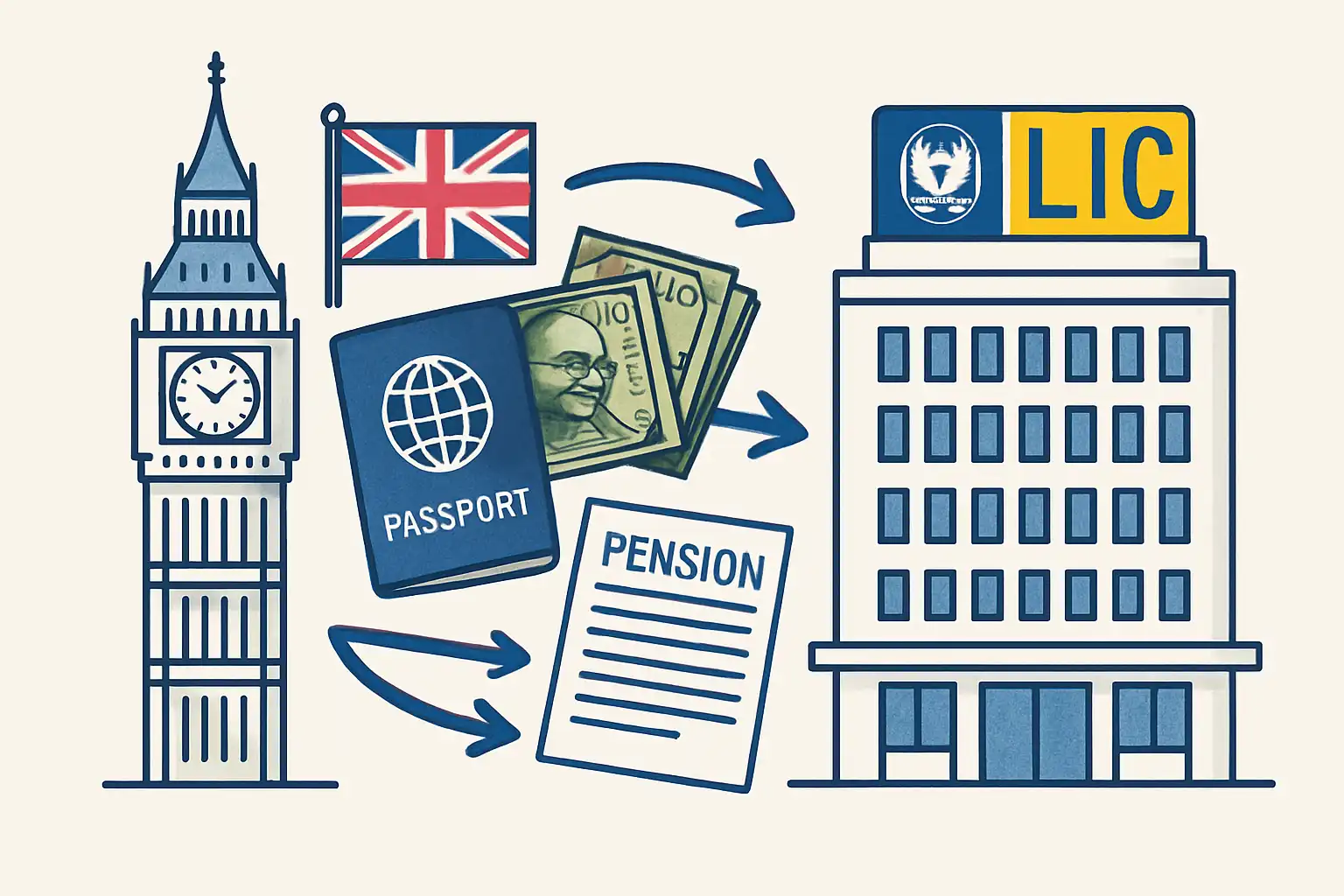
If you built up a pension while working in the UK and now live in India, or plan to retire here, sooner or later you will ask whether that money should stay in Britain or come home. Many people searching for how to transfer QROPS to LIC India have heard that an LIC annuity can receive a UK pension directly. That is partly true, but the details matter a great deal, and a wrong step can cost you a quarter of your fund in UK tax.
This guide explains how a UK pension transfer to India actually works, where LIC fits in, which rules come from the UK and which from India, and what you should check before you sign anything. It is general information, not personal advice. Pension transfers are hard to undo, and the right answer depends heavily on your own residence, age, health, income needs and family situation.
What Is a QROPS?
QROPS stands for Qualifying Recognised Overseas Pension Scheme. It is a pension scheme based outside the UK that meets conditions set by HM Revenue & Customs (HMRC), so that money from a UK registered pension scheme can be transferred into it without being treated as an unauthorised payment.
A few points are often misunderstood:
- HMRC does not “approve” QROPS. It publishes a list of schemes that have told HMRC they meet the conditions, called the Recognised Overseas Pension Schemes (ROPS) notification list. HMRC says plainly that it cannot guarantee a listed scheme is a ROPS, or that a transfer to it will be free of UK tax.
- The list changes. It is usually updated twice a month, and schemes are added and removed.
- A QROPS is the receiving scheme. Your existing UK pension, such as a workplace pension or a personal pension, is the transferring scheme. The UK State Pension cannot be transferred at all.
Why would anyone use one? Mainly because they have left the UK for good and want their retirement savings held, managed and paid in the country where they now live. For some people that is sensible. For others, leaving the money in the UK and drawing it from abroad works just as well, or better.
Can You Transfer a QROPS to LIC India?
The short answer is: it may be possible, but only into specific LIC products, only if they qualify at the time of transfer, and only if the tax position works for you.
At the time of writing (October 2026), HMRC’s ROPS notification list for India included two LIC products, LIC’s Jeevan Akshay VII and LIC’s New Jeevan Shanti, along with annuity and pension plans from several private Indian insurers. Being on the list today does not mean a product will be on it when your transfer is processed, so it should be checked again close to the transfer date.
It also helps to separate two things that are easily confused.
A QROPS transfer means your UK pension scheme sends the money directly to a recognised overseas scheme. The money never passes through your hands. UK transfer rules, including the overseas transfer charge, apply.
Buying an LIC policy with your own money is something different. If you draw money from your UK pension first, pay whatever UK tax applies, send it to India and then buy an LIC annuity, that is simply a purchase. It is not a QROPS transfer, and it has its own tax consequences in both countries.
Neither route is automatically better. People sometimes hear “QROPS to LIC” and assume the whole pension can move into LIC tax-free. That is not how it works.
Practical acceptance is a separate question too. Even if a product appears on the HMRC list, ask LIC (through your agent or branch) whether it is currently accepting direct transfers from UK schemes for that product, and what its process is. A product being listed and a provider being ready to process your particular transfer are two different things.
How QROPS and LIC India Differ
A UK pension, or a QROPS that works like one, is usually a pot of invested money. You can often choose how it is invested, and when you take benefits you may have a choice between a lump sum, flexible withdrawals or buying an annuity.
An LIC annuity works differently. You pay a single lump sum, called the purchase price, and LIC pays you a regular income, either for life or on the terms of the option you choose. With an immediate annuity such as Jeevan Akshay VII, payments begin soon after purchase. With a deferred annuity such as New Jeevan Shanti, payments start after a deferment period that you choose. Annuity options typically differ on points such as whether income continues to a spouse after your death, and whether the purchase price is returned to your nominee.
The trade-off is flexibility. Once you buy an annuity, you generally cannot take the money back out as you could from an invested pension pot. Options for surrender or loans, where available at all, are limited and depend on the plan and option chosen. On the other hand, the income is set out at the start according to the plan terms, which many retirees value.
It is also worth remembering that LIC is a life insurer. Its annuities are insurance contracts regulated in India by IRDAI. That is a different structure from a UK trust-based or contract-based pension scheme regulated by UK bodies, or from India’s own National Pension System (NPS), which is a separate retirement product with its own rules. Do not assume features you are used to in the UK, such as particular drawdown flexibility or the way the 25% UK tax-free lump sum works, carry across.
Why NRIs Consider Moving Retirement Funds to India
There are genuine reasons people look at a pension transfer from the UK to India as part of their NRI retirement planning, and some equally genuine reasons to be cautious.
The most common reason is simple: you will spend your retirement here. Your expenses will be in rupees, your family is here, and you would rather deal with an insurer and bank you can visit than with a UK provider by email and international calls.
Currency is the second reason. If your income stays in sterling and your costs are in rupees, the amount you can spend each month moves with the exchange rate. Converting once and receiving a rupee annuity removes that monthly uncertainty. It does not remove currency risk entirely, though. It simply locks in the rate on the day you convert.
Some people also find estate planning easier when the asset is in India and nominees are family members living here. And some simply prefer a single, regular income to managing an invested fund in their 70s and 80s.
Against this, a rupee annuity gives up flexibility, you lose the option of keeping money in sterling, and the transfer itself may trigger UK tax if you do not meet an exemption. For someone with a large fund, a defined benefit pension or a likely return to the UK, staying put can be the better choice.
QROPS Transfer Process: What an NRI Needs to Check
The exact steps vary between schemes and providers, but most QROPS transfers to India follow a broadly similar path.
- Find out exactly what you have. Ask your UK provider for a statement showing the type of pension (defined contribution or defined benefit), the current transfer value, any guarantees or special benefits, and any exit charges.
- Check whether you need regulated advice. If you are transferring safeguarded benefits, such as a final salary (defined benefit) pension, and the value is over £30,000, UK rules generally require you to take advice from an FCA-authorised adviser before the transfer can go ahead. Even where advice is not compulsory, a pension transfer is a decision where independent advice is usually worth paying for.
- Confirm the receiving product qualifies. Check the current HMRC ROPS list, and confirm with LIC that the specific product and option you want can accept the transfer.
- Work out the UK tax position. Establish whether the overseas transfer charge applies and whether the transfer is within your overseas transfer allowance (both explained below).
- Understand the Indian side. Speak to a tax adviser in India about how the transfer and the later annuity income are likely to be treated in your case.
- Complete the paperwork. Your UK scheme will need forms from you and confirmation from the receiving scheme. UK providers also carry out due diligence and may ask for evidence such as proof of residence. They can delay or refuse a transfer if they are not satisfied.
- Agree the annuity terms before the money moves. Know which option you are buying, the annuity rate, the payout frequency and who the nominee is.
A simple example: Anil, 62, worked in the UK for twelve years, has a defined contribution pension and has lived in India for the last four years. He intends to stay here. In Anil’s case the questions are mainly whether the receiving LIC product is listed and accepting transfers, whether his residence in India satisfies the “same country” exemption, and whether a lifetime annuity suits him better than keeping a flexible fund. If Anil instead had a final salary pension from a UK employer, the first step would be regulated advice, because giving up a guaranteed UK pension is rarely straightforward.
UK Tax Considerations
The UK rules are where most of the cost and risk sits, so read this part carefully. Rules change, and the following reflects the position as generally understood at the time of writing.
The overseas transfer charge
A transfer to a QROPS can attract an overseas transfer charge of 25% of the amount transferred unless an exemption applies. The most relevant exemption for an NRI is that you are resident in the same country as the QROPS. So, broadly, if you live in India and transfer to an Indian QROPS, that exemption may apply. If you live in the UAE or the UK and transfer to an Indian scheme, it would not.
Other exemptions exist, for example for certain employer-provided and public service schemes, but they are less likely to apply to an individual buying an LIC annuity.
Until 30 October 2024, transfers to schemes in the European Economic Area could also be exempt. That exemption was largely removed in the Autumn Budget 2024. Older articles that mention it may now be out of date.
The five-year rule
An exemption that applies at the time of transfer has to keep applying for the following five full UK tax years. If, during that period, you move to another country so that you are no longer resident in the same country as the scheme, the 25% charge can be applied after the event. The reverse can also happen: in some cases a charge already paid can be reclaimed if your circumstances change so that an exemption is met within the period. If there is any chance you might move again in the next few years, this needs careful thought.
The overseas transfer allowance
Since 6 April 2024, transfers to QROPS are also measured against an overseas transfer allowance. For most people this is £1,073,100, reduced by certain earlier transfers and benefits already taken. The part of any transfer above your available allowance is subject to the 25% charge even if you meet an exemption. Most NRIs will be well within this limit, but those with larger funds should check.
Reporting
QROPS have reporting obligations to HMRC for a period after the transfer, typically including payments made to members. That is something LIC and your UK scheme deal with, but it is a reminder that the UK keeps an interest in transferred funds for some years.
Indian Tax Considerations
When it comes to a UK pension and India tax, how India taxes your pension depends on your residential status under Indian tax law, the nature of the payment and the year in which you receive it. It is not possible to say in general terms that a QROPS transfer to India is tax-free or taxable. You should check your own position with a qualified tax adviser in India.
A few principles are useful to understand.
Your residential status in India for the year matters. A person who is resident (and ordinarily resident) is generally taxed in India on worldwide income, while a non-resident is generally taxed only on Indian-source income. Someone who has recently returned to India may fall into an intermediate category for a few years. This can affect how income connected to a UK pension is treated in the years around your move.
Annuity income from an Indian insurer is generally taxable as income in the year you receive it, under the rules applicable to you. The fact that the money originally came from a UK pension does not by itself make the annuity tax-free.
India has a double taxation avoidance agreement with the UK. The treaty decides which country has the right to tax certain kinds of pension income, and the answer can differ for private pensions and government service pensions. Where both countries tax the same income, the treaty and domestic rules may give credit for tax already paid. How the treaty applies depends on your exact circumstances.
India also has a specific relief for residents who hold retirement benefit accounts in notified countries, which include the UK. It was introduced as Section 89A of the Income-tax Act, 1961 and carried into the Income-tax Act, 2025. Broadly, it aims to align the timing of Indian tax on income in those accounts with the timing of tax in the foreign country, and it requires a form to be filed. Whether it is relevant to you depends on whether your money stays in a UK account or moves to India, and on your residential status.
Tax law in both countries changes regularly. Treat any specific rule you read, including in this article, as something to confirm for the year in which you act.
Currency and Exchange-Rate Considerations
When your pension moves from the UK into an LIC annuity, it is converted from pounds to rupees once. Everything after that is in rupees.
That has two effects. First, the exchange rate on conversion day decides how many rupees you have to buy your annuity. A small move in the GBP/INR rate makes a noticeable difference on a large sum. Second, once converted, your income no longer benefits if sterling strengthens, and is no longer hurt if it weakens.
For someone whose spending is entirely in India, a rupee income is often a natural match. For someone who expects to spend time or money in the UK, perhaps visiting children or paying for UK costs, keeping some savings in sterling may make more sense.
Also look at the cost of conversion itself. Banks and transfer services do not always charge a visible fee, but the rate they offer can be noticeably worse than the market rate. On a pension transfer, that spread can amount to a significant sum.
Fees and Costs to Consider
Costs vary widely, and you should ask for every one of them in writing before you go ahead. Depending on your situation, they may include:
- exit or transfer charges from your current UK scheme;
- fees for regulated financial advice in the UK, especially for defined benefit transfers;
- fees for tax advice in India and, if needed, in the UK;
- currency conversion costs, including the exchange-rate margin;
- any charges built into the receiving product, which for an annuity are usually reflected in the annuity rate rather than shown as a separate fee;
- intermediary or introducer fees, if someone other than LIC or your adviser is involved;
- the overseas transfer charge, if an exemption does not apply.
Be wary of anyone who cannot or will not tell you clearly how they are paid. In the UK, pension transfer scams are a recognised problem, and unrealistic promises, pressure to act quickly or cold calls about “releasing” your pension are warning signs.
Documents Typically Required
Exact requirements differ between UK schemes, LIC and the product chosen, but you should expect to provide some or all of the following:
- your UK pension scheme details and the latest statement or transfer value;
- the UK scheme’s transfer forms and any discharge forms;
- proof of identity, such as your passport;
- proof of address and evidence of residence in India;
- your National Insurance number and, if applicable, your Indian PAN;
- LIC’s proposal form and annuity option selection for the chosen product;
- nominee details;
- bank account details for annuity payments;
- confirmation that you have received regulated advice, where this is required.
Ask both sides for a written checklist at the start. It saves time later.
Common Mistakes NRIs Should Avoid
The most frequent mistake is assuming that any Indian pension or insurance product can receive a QROPS transfer. Only schemes that qualify can, and the list changes. A standard LIC endowment or money-back policy, for instance, is not a pension transfer vehicle.
Another is focusing only on tax. Avoiding the 25% charge is important, but an annuity that does not suit your health, your spouse’s needs or your other income can be a poor decision even if it is tax-efficient.
People also ignore currency risk, or think converting to rupees removes it. It does not. It fixes it on one day.
Fees get overlooked, especially exchange-rate margins and intermediary charges that are not shown as a separate line.
Some transfer without checking the receiving scheme’s status close to the transfer date, or without confirming that the provider can actually process the transfer.
Many assume a transfer can be reversed. In practice, once your UK pension has moved and an annuity has been bought, unwinding it is usually very difficult or impossible.
Finally, people rely on old articles. UK rules changed significantly in 2017 and again in 2024, and India has introduced a new Income-tax Act. Information that was accurate a few years ago may not be now.
QROPS to LIC India: Questions to Ask Before Transferring
Before you transfer QROPS to LIC India, or any UK pension to India, it helps to have clear answers to these questions:
- What type of UK pension do I have, and does it include any guarantees I would lose?
- Is regulated advice legally required for my transfer?
- Is the LIC product I want on HMRC’s current ROPS list, and will LIC accept a direct transfer for it?
- Do I meet an exemption from the overseas transfer charge, and am I confident it will still apply for the next five full tax years?
- Is my transfer within my overseas transfer allowance?
- How will the annuity income be taxed in India in my circumstances, and does the India–UK tax treaty change anything?
- Which annuity option suits me and my spouse, and what happens to the money when we die?
- What exchange rate and conversion costs will apply?
- What are all the fees, and who receives them?
- What happens if I need a lump sum later?
If you cannot answer most of these with confidence, it is too early to transfer.
Frequently Asked Questions
Can I transfer my UK pension directly into an LIC policy?
Only into an LIC product that qualifies as a recognised overseas pension scheme at the time of transfer, and only if LIC accepts the transfer. At the time of writing, HMRC’s list included LIC’s Jeevan Akshay VII and New Jeevan Shanti. Ordinary LIC life insurance policies are not QROPS.
Will I pay 25% tax on a QROPS transfer to India?
Not necessarily. The overseas transfer charge does not apply if you meet an exemption, such as being resident in India when transferring to an Indian scheme, and you are within your overseas transfer allowance. The exemption must continue for five full UK tax years after the transfer.
Is LIC on the HMRC QROPS list?
Two LIC annuity products appeared on HMRC’s ROPS notification list at the time of writing. HMRC states that inclusion on the list is not a guarantee that a scheme qualifies or that a transfer will be free of UK tax, and the list changes regularly.
Can I transfer my UK State Pension to India?
No. The UK State Pension cannot be transferred to a QROPS. It can usually be paid to you in India, but that is a separate matter with its own rules.
Is the LIC annuity income tax-free in India?
Annuity income is generally taxable in India in the year you receive it, depending on your residential status and the rules in force. Speak to a tax adviser about your own situation.
Do I need a financial adviser to transfer a UK pension to India?
If you are giving up safeguarded benefits, such as a defined benefit pension worth more than £30,000, UK rules generally require regulated advice. For other transfers it may not be compulsory, but it is often sensible given the amounts involved and the difficulty of reversing a transfer.
Does LIC have a pension for NRIs who want to transfer pension from UK to India?
LIC offers annuity plans that NRIs may be able to buy, subject to LIC’s rules for non-residents. For a direct transfer from a UK scheme, the specific product must qualify as a recognised overseas pension scheme at the time, which is why checking the current HMRC list and confirming with LIC matters.
Can I keep my pension in the UK and still retire in India?
Yes. Many people do. You can usually draw a UK pension while living abroad. Whether that is better than a transfer depends on tax, currency, flexibility and your plans.
What if I move away from India after transferring?
If you move within five full UK tax years of the transfer and no longer meet the exemption that applied, the 25% overseas transfer charge can apply after the event. This is one of the most important points to consider if your future plans are uncertain.
Final Thoughts
For an NRI who has settled in India, wants a dependable rupee income and has checked the tax position carefully, a QROPS transfer to LIC India can be a reasonable option. Two LIC annuities appeared on HMRC’s list at the time of writing, so the route exists. But it is not right for everyone, and it is not a shortcut to tax-free money.
The best decisions come from looking at the whole picture: the type of UK pension you hold, the overseas transfer charge and the five-year rule, Indian tax on the income, currency, fees, and how much flexibility you and your family need later in life. Get the facts for your own case, check that the receiving product qualifies at the time, take regulated advice where it is required, and only then decide whether to transfer QROPS to LIC India or keep your pension where it is.
If you would like help understanding how LIC’s annuity options work, an LIC advisor can explain the products. For the UK transfer and tax questions, speak to an FCA-regulated adviser and a qualified tax professional.